A year-in-review post? Yes, I think there's just enough time for one before I have two years' worth. I do seem to make a habitat of being, umm, fashionably late with writing these.
So, how was 2015? Well, it certainly involved more dipping than I'd have liked. A lot more. Anyone else ever dip two megas in a day before? A suggestion, don't try it.
There was also the odd success here and there, the time I happened to be visiting Scotland while there was a Harlequin Duck in Aberdeen for example...
But for the sake of structure, and in line with a fair percentage of stories, let's start at the beginning.
January
Ah January, the month that deceived me of the twitching failures awaiting in the coming year, with a spell of unprecedented good luck. By the end of the 2nd day of the year I'd already seen Rough-legged Buzzard, Hen and Marsh Harriers and 5 Short-eared Owls. Although I did miss a Barn owl on the drive home...
Next day, Slavonian Grebe showing exceptionally well at Wanstead, and continuing to do so for a further two visits during the month.
Bring on the 29th, where a drive down to Kent had me successfully not missing a Barn Owl. By 10am, having got Bewick's Swan a little earlier, I was watching my third lifer of the day - Cattle Egret, in a field which unfittingly had no cattle. The rest of that day held, among much else, the usual Dungeness goodies: Great-white Egret, Bittern, Smew and Tree Sparrow.
January was a good month.
February
February was the month things started to go a little wrong... but before that happened, let's begin with the 1st, when a spur of the moment trip to the cold of Gunners Park had us freezing to our spines for 3 hours before being rewarded with 2 stunning Serin!
The 9th, I was out twitching again, this time for a bird with yellow legs, it was called a Lesser something or other... and that was it, my first dip of 2015. The first of many.
Just 18 days later, while in Ireland I dipped (not for the first time) the Ballycotton Laughing Gull. Unlike the gull, I didn't find it funny. A stunning American Wigeon saved the day.
Is it worth mentioning that I dipped Ring-necked Duck too?
March
Still in Ireland, I began March in a spectacular way. On the 2nd I headed for the American Coot on Lough Gill, it was out there, Caleb had it in the scope, I looked, and then came the rain, the snow, the hail, the sleet and the strong winds. I could see Coots, but the sudden weather change made it impossible to distinguish which was the American. I'll file that one as a dip. We then headed to look for the Black Scoter. Let's just say the 'dipping file' got a little larger. Later that afternoon, while partaking in lunch a dozen or so miles away, we spotted a single Scoter which seemed... odd. You know, at the time it seemed to reminisce the look of a Black Scoter. When the photos were posted online several others thought the same. So it was, of course, an unusual Common Scoter. Now if that's not a spectacular day, what is?
Things did pick up after returning to England, on the 11th I had great views of a female Black Redstart at Brighton Marina, and a day's birding around Newhaven on the 16th brought my first Richard's Pipit and Jack Snipe.
Not only was March begun spectacularly, but March ended rather spectacularly. Thankfully in a very different way. On the 28th we headed up to Scotland, and on the 30th we took a slight 'diversion', which lead us to Seaton Park. Just for a stroll you know. OK you saw through that, so it may have had something to do with the Harlequin Duck... It was quite a nice stroll too though...
Having driven to Blairgowrie, after the 'stroll', we headed out the following morning to look for Grouse. And we found Grouse. By midday we had seen over 20 Black Grouse and 10 Red Grouse as well as a Short-eared Owl!
March was not all bad.
April
I started the month photographing Grouse, Mountain Hares and walking up a mountain through a foot or two of snow - No, London hadn't changed that much, I was still in Scotland.
On the 2nd I was back in England, and on the 16th I cycled 12 miles to look at a field. It wasn't even an interesting field. It was interesting earlier that morning of course, as it had a Hoopoe in it then. But when I arrived it was just a field. Hoopoe-less and birder-filled. Dip.
The next day we headed to Abberton reservoir (thankfully not on bicycles) for what proved a more successful day's birding. An awfully stunning drake Garganey, and after a few hours of chasing sounds and staring at a hedge, a Nightingale!
8 days later, I was once again to spend several hours chasing sounds, this time craning my neck up to the canopy to eventually spot a Wood Warbler. When it appeared, it made the neck-pain worthwhile.
May
Grey Wagtail fledglings! Always a highlight of Spring, they turned up in the park on the 1st.
A seawatch a few days later provided Little Tern, as well as Arctic Skua and Bonxie. And didn't, I repeat didn't require an early start. That was an odd seawatch.
On the 9th, after many years of being driven mad ( you might even say Cuc.... No, I won't say it) by hearing them and not seeing them, I finally saw a Cuckoo. Two actually.
Perhaps most surprising though, I got an interesting bird on the patch. Yes, I couldn't believe it either. A Hobby, dashing over and out of the park on the 15th.
On the 25th things changed. On the 25th I went looking for moths. The highlight was the scarce Commophila aeneana, along with 11 other species. A Eucosma metzeriana was the only other moth of real note for May.
There wasn't all that much birding for the next few months.
June
Probably the last spot of birding I did before August, a trip to Lakenheath for the Little Bittern. The Little Bittern which sat there calling the whole time. To avoid confusion, let me adjust that. The Little Bittern which sat there out of sight calling the whole time. Need I say it? Dip.
Throughout June my garden played the afternoon resting spot of a rather 'chill' fox. With the views it gave, I wasn't complaining!
There were a lot of moths in June, to save keyboard wear, I'll summarise it to - There were some cool moths in June.
July
An appropriate summary of July however would have been - There were a lot of cool moths in July. An awful lot.
Towards the end of the month we headed to Wales for a week's camping. After two days I was successfully put off camping. It's never nice to wake up and find that rain's been sneaking in your tent all night. Never. The moths were worth it though. Many, many hours of walking around, day and night, and we managed 95 species, including two county firsts.
August
On the 3rd I headed off for a month or so in Ireland. The only birding we did were two Pelagic trips, and, other than the constant worry that comes hand-in-hand with being out at sea for 5 hours with a stomach of a somewhat weak constitution, I found that I like Pelagic's...
Storm Petrel, Sooty Shearwater, Grey Phalarope, Bonxie and Long-tailed Skua, are all thing that are 'likeable' I would say. A small pod of Minke Whale and a load of Dolphin aren't half bad either.
And of course, there were some moths in Ireland too. Through the endless Square-spot Rustics, Agriphila straminella and Blastobasis adustella, I managed to see around 140 species.
September
After Ireland, I was back on the patch on the 12th, when I had my 2nd Hobby for the park this year.
On the 19th, I was rather surprisingly awarded the ZSL Animal Photography Prize 2015 Junior winner. Not sure what happened there...
The 21st held A Grey Phalarope that 'only' showed down to 17 foot, at Cuckmere. On the 25th I finally mixed things up, managing to do a successful twitch. Yes, an actual successful twitch. I wasn't sure it was possible either, but the hyperactive blob could be nothing other than a Wilson's Phalarope. A few Little Stint were a nice bonus!
October
October... October, what happened in October? Hmm, well I dipped a Yellow-browed Warbler, took a lot of photos of Grey Wagtails, and umm... oh yes, spent an excellent £2.25 to see an Osprey at Southease. That was October.
November
Rather embarrassingly, I dipped a butterfly two days running. What a way to kick-start the month. It turns out Long-tailed Blue aren't that easy to see.
I also at last got myself a moth-trap, a little late in the year, but I still had a fair amount turning up.
To answer your question, no, I did no birding. I did have a regular Firecrest in the garden however, and garden-ticked Treecreeper.
December
The final month of the year (I'm sure you know that though...). Not exactly a bird-filled month, but it did hold my first ever Caspian Gull on the 11th, so not bad, not bad at all.
A trip to Rainham on the 3rd was intended for birding, but I got distracted by a few Agonopterix alstromeriana - my 400th moth species of the year.
So, there we have it, a rough overview of my year as an extremely successful dipper. That's something to aspire to, right?
Showing posts with label Review. Show all posts
Thursday, 28 January 2016
Friday, 16 January 2015
Year in Review 2014
That time of year has come again (and pretty much gone, I'm a bit late!) for the Year-in-Review post. 2014 was another great year, and one which involved more twitching than I care to admit. That's not to say though that given the opportunity I wouldn't have twitched more... I know, what's wrong with me? It wasn't just a year of twitching though, I visited the patch probably close to a hundred times, became obsessed with Lepidoptera, and well.. that's my whole year. Unless you want a bit more detail? Ah, go on then!
January
January started out with atrip twitch down to the South-Essex coast for Spoonbill (lifer) on the 3rd. It gave good views, if a little distant, before doing what Spoonbills do best. Sleeping.
On the 6th, news came in of a Grey Phalarope (lifer) in Hove showing ridiculously well. After talking to people who had been, and being told "Go, now!", I walked the five miles there - of course, it ended up staying for few weeks. It showed like a dream, giving amazingly close views! On the 8th I went for the Phalarope again, and got even better views, perhaps less than a foot away at times! Definitely up there with my top birds of the year.
The 11th saw another local lifer, Cetti's Warbler at Fisher's Green, the views of this weren't quite as good.
February
Ah, February, the month of Gulls, or so it was for me. Caleb was over from Ireland on the 8th, so a trip to Newhaven was due on the 9th. A stunning male Black Redstart and Purple Sandpipers showing well made the day.
On the 12th, I set off for Ireland. But winds of 110mph in Cork meant no planes were flying out, 5 hours in the airport, then it was just back home. The next day things were back on track, and I reached Ireland! In the end it was worth it.
The 15th was just a visit to a local beach, but we found a Little Gull, a 1w Glaucous (lifer). Then came the 16th, spontaneity was the key that day. A sudden decision to go for a female King Eider had us rushing to get packed. On the way even, we managed some lifers - at a pull-in we saw Yellow-legged Gull (lifer), another Glauc, and a flyby Ring-billed Gull (lifer). Then on to Cahermore where we got distant views of the Eider (lifer).
The 20th, saw us watching Ross's Gull (lifer) at close quarters, and finding ourselves a Kumlien's Gull. Throughout the rest of the trip we had a four more Ring-billed Gulls, two Iceland and a few more Glaucs. See, lots of Gulls!
March
Spring began to set into action in March, with a few Chiffchaffs on the patch and even some Goslings.
The 30th began the start of perhaps a small addiction, seawatching. The early starts, the distant birds, wha'ts not to love?! I don't jest. I had a 100+ Common Scoter, 10 Red-throated Divers and 100's of Brent Geese. In all fairness it was a bit early in the year for good seawatching.
In March I was also pleased to find I was named the Junior Scottish nature Photographer of the year.
This Kestrel at Kew Gardens was the photography highlight of March...
April
A pair of Common Scoter on a London reservoir were nice to see and started off a great month.
On the 11th Caleb was over from Ireland again, so, we headed out for a days birding in Suffolk. Our first stop at Cavenham Heath got us Woodlark and Stone Curlew (both lifers), before heading on to Lynford for Crossbills. A few hours there gave us Common Crossbill, and Brambling, but just as we were leaving, the male and female Two-barred (lifer) showed up! Sitting at the top of a pine tree showing really well. The car-park here also held Firecrest and Marsh Tit. We finished the day off with a Crane (lifer) and a few Marsh Harriers at Lakenheath Fen.
Seaford Head on the 14th, gave us a couple of cracking male Redstarts, 3 Wheatear, and a Spoonbill.
The 18th was undoubtedly one of my favourite days of the year, nothing rare, but a day of photographing fledgling Grey Wagtails at close range!
It was back at Seaford for the 21st, for an incredible session seawatching. Sightings included Whimbrel, Razorbill, Guillemot, Red-breasted Merganser, Med gull, Arctic Skua (lifer), Bonxie (lifer), Black-throated Diver (lifer), Red-throated Diver and a Short-eared Owl in off the sea. A Shorelark (lifer) was another surprise in off the sea! A female Mandarin (lifer) and Black Tern (lifer) were added here on the 29th.
May
Garden Warbler was a nice local lifer at Wanstead Flats on the 4th, along with my first Swifts of the year! Always enjoy it when they come back.
My lens ended up useless in May, due to a broken image-stabiliser. I had a few dips here and there, and I struggled and failed to get Willow Warbler for the year-list.
June
My unlucky streak somewhat continued into June, dipping a Marsh Warbler on the 1st. The 12th, however brought tidings of joy. Three year-ticks at Rainham, including a Bearded Tit, and on the 13th I finally got Willow Warbler. About time.
The 19th... a twitch down to Ashdown Forest for the Short-toed Eagle, started and ended terribly! But going back the following day was a great move, I got stunning views of the Eagle (lifer) perched, and got Tree Pipit (lifer) and Redstart in the surrounding area. The Tree Pipit was also my 200th British bird!
My lens came back from repairs near the end of the month, and on the 29th I had good views of two Tawny Owlets in Kensington Gardens.
July
July started quite slow, but I was out in Ireland again on the 15th for five days. Being able to watch Natterjack Toadlet's was by far the highlight of this trip, and quite a surprise to find. Then all my attention turned to Butterflies, before transitioning rapidly to moths! Highlights include Pine Hawkmoth, Poplar Hawkmoth, Pale prominent... there were too many to name.
A trip out to Minsmere on the 28th was a nice break back to birds, with Bittern, Bearded Tit, Spot-Redshank and Avocet, followed by 5 Dartford Warblers (lifer) at a nearby site.
August
In August I was off to Ireland, again, yet another successful trip. On the 10th we headed to Brandon Point for a spot of seawatching, it wasn't as easy as Seaford I can tell you that! But I did end up with Great and Sooty Shearwater, both lifers!
Several nights which turned into the early morning while mothing produced some good results, Early Thorn, Lesser Swallow Prominent, and Pink-barred Sallow were some favourites. Oh, and I don't want to forget a Long-billed Dowitcher (lifer) on the 25th! A crazy twitch, practically halfway across the country! I also got hen Harrier and my first Red Squirrel, so worth the drive.
September
On the 8th I was back at Seaford, for an amazing day of birding. We started off with c.4000 House martin flying around the cliffs, sometimes right over our heads! Then continued to find 30+ Yellow wagtail, 30+ Wheatear, Redstart, Whinchat, and a basking female Adder! Certainly a memorable day.
I didn't do much more birding in September, except a couple of visits to the patch, where I found that the female Kingfisher had returned for the winter.
October
I finally found a Patch Gadwall on the 1st, two males and a female on the main lake.
The 5th had me finding a Firecrest in my garden, and, on the 15th I headed to Wanstead Flats for Ring Ouzel (lifer), we managed to see two males.
The next morning a Lapland Bunting (lifer) was reported on the Flats, so we were over there quickly, and managed some great views of this smashing local bird!
An early start the next day, had us off to Richmond Park to photograph the Red Deer rut. Although we didn't get the sunrise we were hoping for it was a good day of photography.
I'd been debating upgrading my lens for a while now, and I decided that it was time. And on the 22nd I became the owner of a Canon 400mm f5.6, a beautiful lens!
The 24th held my first Yellow-browed Warbler, an active little bird at Regent's Park. And a fantastic visit - sorry twitch - to Beachy Head on the 27th was for the most stunning of Siberian migrants. A male Red-breasted Flycatcher. And a showy one at that!
November
Things slowed down again in November, and it was really just a month of patch birding. Still a great month though, with lots of great views of Kingfisher, Med Gull and Grey Wagtails. I got a lot of photography done, although the Wagtails and Med Gull seemed to like coming too close to the camera!
December
On the 8th (the day after my 15th birthday) I headed to Newhaven with Caleb, where we were lucky enough to find ourselves a Snow Bunting! A winter plumaged (naturally) male, who showed supremely well for the four or so hours we photographed him. What a treat!
Throughout December the Grey Wagtails continued to show wonderfully on the patch, at times I believe down to just four-and-a-half foot. A great end to a great year....
January
January started out with a
On the 6th, news came in of a Grey Phalarope (lifer) in Hove showing ridiculously well. After talking to people who had been, and being told "Go, now!", I walked the five miles there - of course, it ended up staying for few weeks. It showed like a dream, giving amazingly close views! On the 8th I went for the Phalarope again, and got even better views, perhaps less than a foot away at times! Definitely up there with my top birds of the year.
The 11th saw another local lifer, Cetti's Warbler at Fisher's Green, the views of this weren't quite as good.
February
Ah, February, the month of Gulls, or so it was for me. Caleb was over from Ireland on the 8th, so a trip to Newhaven was due on the 9th. A stunning male Black Redstart and Purple Sandpipers showing well made the day.
On the 12th, I set off for Ireland. But winds of 110mph in Cork meant no planes were flying out, 5 hours in the airport, then it was just back home. The next day things were back on track, and I reached Ireland! In the end it was worth it.
The 15th was just a visit to a local beach, but we found a Little Gull, a 1w Glaucous (lifer). Then came the 16th, spontaneity was the key that day. A sudden decision to go for a female King Eider had us rushing to get packed. On the way even, we managed some lifers - at a pull-in we saw Yellow-legged Gull (lifer), another Glauc, and a flyby Ring-billed Gull (lifer). Then on to Cahermore where we got distant views of the Eider (lifer).
The 20th, saw us watching Ross's Gull (lifer) at close quarters, and finding ourselves a Kumlien's Gull. Throughout the rest of the trip we had a four more Ring-billed Gulls, two Iceland and a few more Glaucs. See, lots of Gulls!
March
Spring began to set into action in March, with a few Chiffchaffs on the patch and even some Goslings.
The 30th began the start of perhaps a small addiction, seawatching. The early starts, the distant birds, wha'ts not to love?! I don't jest. I had a 100+ Common Scoter, 10 Red-throated Divers and 100's of Brent Geese. In all fairness it was a bit early in the year for good seawatching.
In March I was also pleased to find I was named the Junior Scottish nature Photographer of the year.
This Kestrel at Kew Gardens was the photography highlight of March...
April
A pair of Common Scoter on a London reservoir were nice to see and started off a great month.
On the 11th Caleb was over from Ireland again, so, we headed out for a days birding in Suffolk. Our first stop at Cavenham Heath got us Woodlark and Stone Curlew (both lifers), before heading on to Lynford for Crossbills. A few hours there gave us Common Crossbill, and Brambling, but just as we were leaving, the male and female Two-barred (lifer) showed up! Sitting at the top of a pine tree showing really well. The car-park here also held Firecrest and Marsh Tit. We finished the day off with a Crane (lifer) and a few Marsh Harriers at Lakenheath Fen.
Seaford Head on the 14th, gave us a couple of cracking male Redstarts, 3 Wheatear, and a Spoonbill.
The 18th was undoubtedly one of my favourite days of the year, nothing rare, but a day of photographing fledgling Grey Wagtails at close range!
It was back at Seaford for the 21st, for an incredible session seawatching. Sightings included Whimbrel, Razorbill, Guillemot, Red-breasted Merganser, Med gull, Arctic Skua (lifer), Bonxie (lifer), Black-throated Diver (lifer), Red-throated Diver and a Short-eared Owl in off the sea. A Shorelark (lifer) was another surprise in off the sea! A female Mandarin (lifer) and Black Tern (lifer) were added here on the 29th.
May
Garden Warbler was a nice local lifer at Wanstead Flats on the 4th, along with my first Swifts of the year! Always enjoy it when they come back.
My lens ended up useless in May, due to a broken image-stabiliser. I had a few dips here and there, and I struggled and failed to get Willow Warbler for the year-list.
June
My unlucky streak somewhat continued into June, dipping a Marsh Warbler on the 1st. The 12th, however brought tidings of joy. Three year-ticks at Rainham, including a Bearded Tit, and on the 13th I finally got Willow Warbler. About time.
The 19th... a twitch down to Ashdown Forest for the Short-toed Eagle, started and ended terribly! But going back the following day was a great move, I got stunning views of the Eagle (lifer) perched, and got Tree Pipit (lifer) and Redstart in the surrounding area. The Tree Pipit was also my 200th British bird!
My lens came back from repairs near the end of the month, and on the 29th I had good views of two Tawny Owlets in Kensington Gardens.
July
July started quite slow, but I was out in Ireland again on the 15th for five days. Being able to watch Natterjack Toadlet's was by far the highlight of this trip, and quite a surprise to find. Then all my attention turned to Butterflies, before transitioning rapidly to moths! Highlights include Pine Hawkmoth, Poplar Hawkmoth, Pale prominent... there were too many to name.
A trip out to Minsmere on the 28th was a nice break back to birds, with Bittern, Bearded Tit, Spot-Redshank and Avocet, followed by 5 Dartford Warblers (lifer) at a nearby site.
August
In August I was off to Ireland, again, yet another successful trip. On the 10th we headed to Brandon Point for a spot of seawatching, it wasn't as easy as Seaford I can tell you that! But I did end up with Great and Sooty Shearwater, both lifers!
Several nights which turned into the early morning while mothing produced some good results, Early Thorn, Lesser Swallow Prominent, and Pink-barred Sallow were some favourites. Oh, and I don't want to forget a Long-billed Dowitcher (lifer) on the 25th! A crazy twitch, practically halfway across the country! I also got hen Harrier and my first Red Squirrel, so worth the drive.
September
On the 8th I was back at Seaford, for an amazing day of birding. We started off with c.4000 House martin flying around the cliffs, sometimes right over our heads! Then continued to find 30+ Yellow wagtail, 30+ Wheatear, Redstart, Whinchat, and a basking female Adder! Certainly a memorable day.
I didn't do much more birding in September, except a couple of visits to the patch, where I found that the female Kingfisher had returned for the winter.
October
I finally found a Patch Gadwall on the 1st, two males and a female on the main lake.
The 5th had me finding a Firecrest in my garden, and, on the 15th I headed to Wanstead Flats for Ring Ouzel (lifer), we managed to see two males.
The next morning a Lapland Bunting (lifer) was reported on the Flats, so we were over there quickly, and managed some great views of this smashing local bird!
An early start the next day, had us off to Richmond Park to photograph the Red Deer rut. Although we didn't get the sunrise we were hoping for it was a good day of photography.
I'd been debating upgrading my lens for a while now, and I decided that it was time. And on the 22nd I became the owner of a Canon 400mm f5.6, a beautiful lens!
The 24th held my first Yellow-browed Warbler, an active little bird at Regent's Park. And a fantastic visit - sorry twitch - to Beachy Head on the 27th was for the most stunning of Siberian migrants. A male Red-breasted Flycatcher. And a showy one at that!
November
Things slowed down again in November, and it was really just a month of patch birding. Still a great month though, with lots of great views of Kingfisher, Med Gull and Grey Wagtails. I got a lot of photography done, although the Wagtails and Med Gull seemed to like coming too close to the camera!
December
On the 8th (the day after my 15th birthday) I headed to Newhaven with Caleb, where we were lucky enough to find ourselves a Snow Bunting! A winter plumaged (naturally) male, who showed supremely well for the four or so hours we photographed him. What a treat!
Throughout December the Grey Wagtails continued to show wonderfully on the patch, at times I believe down to just four-and-a-half foot. A great end to a great year....
Saturday, 13 December 2014
Wildlife Watching Supplies Neoprene Lens Cover Set
If you've invested in a lens it's important to protect it. The last thing you want to do is knock it and end up with a chip or a scratch. Neoprene covers are a great way to prevent this, they provide a soft padded covering for your lens. Wildlife Watching Supplies' cover is made from sections of shock-absorbing 4mm thick water-proof neoprene. Your lens is effectively safe from knocks and scratches. It also offers fairly effective weatherproofing, but not complete - there are small gaps between the neoprene sections. For full weather proofing I suggest their bag cover.
You can choose from a range of different patterns/colours for your cover, mine is in Advantage Timber camouflage, and is reversible to be Olive Green.
In the field, I find it makes it far more comfortable when holding your lens, the soft neoprene is certainly nicer than the metal! And it'll help prevent it overheating or even getting too cold if you're shooting in extreme environments. My only qualm is that it can make operating switches on your lens slightly awkward. By pulling back the section covering them it will make it a lot easier to use.
With lenses that zoom, or have retractable lens hoods, the set will contain a neoprene section with Velcro, so it can be strapped on when the lens is zoomed in or the hood extended, it can then be quickly and easily removed when you are finished.
Whether or not you will definitely benefit from one of these can depend on what sort of photographer you are, if you're going to be out in all terrains and in all weather, then make sure you have one. Even if you aren't though, I would personally advise owning a cover for your lens, just for the peace of mind, and to keep it in top condition!
You can choose from a range of different patterns/colours for your cover, mine is in Advantage Timber camouflage, and is reversible to be Olive Green.
In the field, I find it makes it far more comfortable when holding your lens, the soft neoprene is certainly nicer than the metal! And it'll help prevent it overheating or even getting too cold if you're shooting in extreme environments. My only qualm is that it can make operating switches on your lens slightly awkward. By pulling back the section covering them it will make it a lot easier to use.
With lenses that zoom, or have retractable lens hoods, the set will contain a neoprene section with Velcro, so it can be strapped on when the lens is zoomed in or the hood extended, it can then be quickly and easily removed when you are finished.
Whether or not you will definitely benefit from one of these can depend on what sort of photographer you are, if you're going to be out in all terrains and in all weather, then make sure you have one. Even if you aren't though, I would personally advise owning a cover for your lens, just for the peace of mind, and to keep it in top condition!
Labels:
Camera,
Cover,
Lens,
Neoprene,
Product review,
Review,
Set,
Supplies,
Watching,
Wildlife,
WWS
Friday, 21 November 2014
Wildlife Watching Supplies Bean Bag Review.
For me the Wildlife Watching Supplies Double Bean Bag is a vital piece of kit for any photographer. I rarely go out photographing without it. I find I use it much more than my tripod - not only is it lighter and more easily transported but it can be used in a greater array of situations. The Bean Bag provides a solid support for telephoto lenses, but is also useful for macro and wide-angle work. It's adaptable, and that's the reason I love this product so much. You can rest it on the ground, on car windows, fence-posts, the branches of trees (the list goes on) and it will provide you with a stable base from which to shoot, allowing you to get sharper images even in low light conditions. I've found myself shooting at as low as 1/80 of a second shutter speed and still retaining sharp images.
Male Blackbird taken at 1/80th
The Double Bean Bag comes in Advantage Timber camouflage and is made of a durable material. It has two liner bags which you fill with grain or seed (personally I use rice), it also comes with a padded shoulder strap, so it's comfortable to carry when you're out for a day of photography. Although if it does start to drag down on your shoulder (it weighs about 2-3kg) you can always take out one of the two liner bags, halving the weight, and it will still provide you with a great support.
Resting on a wall to provide a solid support
Ground level work is where it really comes into its own, it allows you to shoot at eye-level with ground feeding birds and water birds and even mammals, in a much more comfortable fashion than if you were hand-holding your camera. The lack of shake from your hands will also help you compose images better as well as keeping them sharper.
Over the past year I've been working on a project photographing Grey Wagtails at my local park. The Bean Bag has helped me a lot in this project, enabling me to get eye-level images as they feed along the edge of a small canal.
Grey Wagtail feeding
I hope now you agree with me, this is a must-buy for any wildlife photographer. It's versatile, sturdy and easily transportable, you'll find yourself getting shots that may otherwise not have been possible.
Downsides? There aren't really any, if the weight is a problem for you, removing one of the liner bags is an easy solution.
If you don't already own the Wildlife Watching Supplies Double Bean Bag, what are you waiting for? You won't regret it.
You can find it here
Resting on a wall to provide a solid support
Ground level work is where it really comes into its own, it allows you to shoot at eye-level with ground feeding birds and water birds and even mammals, in a much more comfortable fashion than if you were hand-holding your camera. The lack of shake from your hands will also help you compose images better as well as keeping them sharper.
Over the past year I've been working on a project photographing Grey Wagtails at my local park. The Bean Bag has helped me a lot in this project, enabling me to get eye-level images as they feed along the edge of a small canal.
Grey Wagtail feeding
I hope now you agree with me, this is a must-buy for any wildlife photographer. It's versatile, sturdy and easily transportable, you'll find yourself getting shots that may otherwise not have been possible.
Downsides? There aren't really any, if the weight is a problem for you, removing one of the liner bags is an easy solution.
If you don't already own the Wildlife Watching Supplies Double Bean Bag, what are you waiting for? You won't regret it.
You can find it here
Sunday, 5 January 2014
Year in Review 2013
2013 was a great year, and I was to say the least very lucky! I went to Scotland, Ireland and many places around England, and at these sites I saw some incredible wildlife from Whales, Otters, Bitterns, Owls... oh the list goes on. You could take it as far as to say that the wildlife spoiled me in 2013. So as you can imagine to write up all these experiences in one post would take the better part of your day to read and the best part of several days for me to write. So I'll just stick to the highlights....
January
One of my best moments from January was seeing the Bearded Tits in Hyde Park. As they were in a small reed bed they couldn't help but show well, so I made a few visits to them. Waxwings were also on the agenda and I got some fantastic views, this was however whilst I still used a bridge-camera. That brings me nicely to the last topic of January. This was when I took the plunge and invested in a lens. The move to DSLR advanced my photography greatly without the restrictions of a bridge camera in the way. So a lot of January was spent getting used to the new kit.
February
The 2 biggest trips I took in February were to Dungeness and to Ireland. Although I won't forget to mention the trip to Bushy Park where we saw a Lesser-spotted Woodpecker.
Dungeness was a huge success with 9 lifers, including Black Redstart, Drake Smew, Bean Geese and Great-white Egret!
Ireland was also great with 5 life-ticks managed including Kumliens Gull and Scaup. The Kumliens Gull was quite a surprise and it more than made up for the fact that I dipped a Spoonbill.
Not a lifer, but a White-tailed Eagle also showed well soaring overhead for a couple of minutes at a local beach.
March
I started off March on a high with Goosander and Slavonian Grebe at a Walthamstow Reservoir. And if that wasn't enough an exhibition of my photography was hosted by the City of London at a couple of sites around Epping Forest which was fantastic! I also got into a local newspaper as a result.
To top it all off I went to Scotland in March too, which was, unbelievable. The highlight for me was seeing a Sperm Whale in Oban Harbour. It was breathtaking to see, the shear size of the thing! It was estimated to be about 40 foot long and weighed around 20 tonnes. It was just incredible, something I'm sure I won't be forgetting any day soon.
Oban Harbour is also home to Black Guillemots and Otters, both of which showed ridiculously well, the Guillemots down to 5 foot at times. So I tried for some portrait shots which is all well and good but looking back now I wish I'd spent a little more time trying some other stuff.
When we were driving back to Glasgow -before heading back to England- we stopped off to look at the ruins of a castle. It just so happened that I looked up to see an Osprey going over, quite a surprise. Unfortunately the big lens was left in the car, I've learnt that lesson now.
I managed 5 life-ticks in Scotland, a trunk load of pictures and left with some incredible memories.
April
April was a bit of a quiet month, that is to say there weren't really any big trips out. That's not to say that it passed without interest though, after all it is when most migrants start arriving. In my garden I had a Pied Flycatcher and a Whitethroat, at Rainham Marshes I had a Little-ringed Plover and a visit to Wanstead Flats showed up 5 Wheatear.
May
May again was a little bit quiet, I spent a lot of time at Kensington Gardens though, especially after I found out you could hand feed most of the birds there. I didn't just hand feed the birds though, no I also managed to see nesting Treecreepers and the Little Owl.
I was also at the patch fairly regularly -as every patch birder should. There were of course the young birds, Cygnets, Gosling's Ducklings... but also I managed to find a pair of Great-crested Grebe. Somewhat of a patch rarity. I had high hopes that they would breed here, especially after I was lucky enough to see their courtship. It wasn't to be though and after a week or two they were gone.
June
In June I was in Ireland again and I was treated to a visit to Skellig islands, it was an unbelievable day. Over 60,000 Gannets as well as Puffins, Guillemots, Razorbills, Manx Shearwater... but I must say in my eyes that wasn't the best part, in my opinion that was when a Pilot Whale came up about 40 foot from the boat. I do like whales....
Back from Ireland I went on one of my rare twitches. I went to see the Long-tailed Duck that was residing on a small lake in the heart of London. As they are usually to be found out at sea photographing them isn't always easy, so an inland one was definitely worth a visit, and it didn't disappoint.
July
In July I bought myself a 7D, quite expensive but so far it's proved worth it. I'll look at it as a long-term investment, that way it puts my mind more at ease.
The first big trip out with the camera was to Elmley Marshes, We had Avocets, Lapwings, Marsh Harriers, Reed and Sedge Warbler, just a quite nice if a little hot day out. I would post a picture from the day but, errr I might have lost them. All of them, not too sure how but... Oh well.
Another big trip out was to Minsmere where I saw Green, Wood and Curlew Sandpiper, Knot, Little Gull and the star, a showy Bittern! Again I managed to lose all of my shots from that day, I managed to restore some of the ones of the Bittern but not my best. I must be more careful.
Last but not least I had a Med Gull in full summer plumage go by my garden, it totally shocked me!
August
I was back in Ireland again in August, the biggest trip was again to an island, this time Cape Clear island in the hope of seeing some of the thousands of Shearwater that go by there each hour. Oh we saw them all right but they were a little bit further away than we had hoped. So there was no chance of picking up Sooty or Great Shearwater. Instead we focussed on the Fulmars who live on the island, by the end of the day I had managed some decent in flight images of them, though it wasn't easy. Unlike the Shearwaters you see the Fulmars kept coming too close, but one or two successes were had.
I also had a Minke Whale out at sea! My third species of whale in one year!
Most of the rest of my time in Ireland was spent photographing some of the butterfly species that lived here, concentrating mainly on Silver-Washed Fritillary and Small Copper. While I was there I saw 18 species of butterfly, I'm hoping by next year I will be able to afford a macro lens, that way I might have some slightly better shots of them.
September
I mostly did local birding in September. I visited Wanstead Flats a fair few times, and I managed to catch up with a few Whinchat and a very showy female Kestrel who didn't mind me taking a few shots.
Other than that and a quick trip to Rainham Marshes where I had Kestrels, Hobby and Marsh Harriers that was about it for September.
October
The patch started to pick up in October with the return of Valentino the Med Gull and the discovery of some rather confiding Grey Wagtails.
The highlight of this month, however, has to be the Red Deer rut, I had an amazing couple of mornings at Richmond Park photographing the Deer, something I definitely hope to do again next October.
November
Due to Storm damage early on my patch was closed for the best part of November, so naturally very little patch birding done.
I was surprised to hear - in October I believe - that I had been placed highly commended in the Suffolk Wildlife Trusts YoungWildlife Photographer competition. And on the 29th of November I went to an awards ceremony down in Suffolk for the competition.
While I was in Suffolk I did some birding and saw Crossbills and Hawfinches, two members of the finch family I've wanted to see for a long time!
I also managed to catch up with the Tawny Owls at Kensington gardens again. They showed superbly if not just a little but too high. But it was nice to finally get a proper picture of one, fingers crossed for the owlets this year!
December
In December I turned fourteen and the day before my birthday I went birding. I had some crazy views of a Great-Grey Shrike in the morning. It came within two foot of me at one point! I spent so long photographing it that there was only time for one more stop so we decided to go for Purple Sandpipers. They showed well but there was basically no light left for any pictures, the shrike was a different story.
Through December my patch started to get better with a few Redwings, about a dozen Shoveler, the continued fantastic views of Grey Wagtail, and then on the 28th it really got good. I saw my first patch Kingfisher! It showed pretty well the second time around too.
So there we have it, my year in review, and what a year! I'm sure you'll agree. So let's see what 2014 will bring!
Dungeness was a huge success with 9 lifers, including Black Redstart, Drake Smew, Bean Geese and Great-white Egret!
Ireland was also great with 5 life-ticks managed including Kumliens Gull and Scaup. The Kumliens Gull was quite a surprise and it more than made up for the fact that I dipped a Spoonbill.
Not a lifer, but a White-tailed Eagle also showed well soaring overhead for a couple of minutes at a local beach.
March
I started off March on a high with Goosander and Slavonian Grebe at a Walthamstow Reservoir. And if that wasn't enough an exhibition of my photography was hosted by the City of London at a couple of sites around Epping Forest which was fantastic! I also got into a local newspaper as a result.
To top it all off I went to Scotland in March too, which was, unbelievable. The highlight for me was seeing a Sperm Whale in Oban Harbour. It was breathtaking to see, the shear size of the thing! It was estimated to be about 40 foot long and weighed around 20 tonnes. It was just incredible, something I'm sure I won't be forgetting any day soon.
Oban Harbour is also home to Black Guillemots and Otters, both of which showed ridiculously well, the Guillemots down to 5 foot at times. So I tried for some portrait shots which is all well and good but looking back now I wish I'd spent a little more time trying some other stuff.
When we were driving back to Glasgow -before heading back to England- we stopped off to look at the ruins of a castle. It just so happened that I looked up to see an Osprey going over, quite a surprise. Unfortunately the big lens was left in the car, I've learnt that lesson now.
I managed 5 life-ticks in Scotland, a trunk load of pictures and left with some incredible memories.
April
April was a bit of a quiet month, that is to say there weren't really any big trips out. That's not to say that it passed without interest though, after all it is when most migrants start arriving. In my garden I had a Pied Flycatcher and a Whitethroat, at Rainham Marshes I had a Little-ringed Plover and a visit to Wanstead Flats showed up 5 Wheatear.
May
May again was a little bit quiet, I spent a lot of time at Kensington Gardens though, especially after I found out you could hand feed most of the birds there. I didn't just hand feed the birds though, no I also managed to see nesting Treecreepers and the Little Owl.
I was also at the patch fairly regularly -as every patch birder should. There were of course the young birds, Cygnets, Gosling's Ducklings... but also I managed to find a pair of Great-crested Grebe. Somewhat of a patch rarity. I had high hopes that they would breed here, especially after I was lucky enough to see their courtship. It wasn't to be though and after a week or two they were gone.
June
In June I was in Ireland again and I was treated to a visit to Skellig islands, it was an unbelievable day. Over 60,000 Gannets as well as Puffins, Guillemots, Razorbills, Manx Shearwater... but I must say in my eyes that wasn't the best part, in my opinion that was when a Pilot Whale came up about 40 foot from the boat. I do like whales....
Back from Ireland I went on one of my rare twitches. I went to see the Long-tailed Duck that was residing on a small lake in the heart of London. As they are usually to be found out at sea photographing them isn't always easy, so an inland one was definitely worth a visit, and it didn't disappoint.
July
In July I bought myself a 7D, quite expensive but so far it's proved worth it. I'll look at it as a long-term investment, that way it puts my mind more at ease.
The first big trip out with the camera was to Elmley Marshes, We had Avocets, Lapwings, Marsh Harriers, Reed and Sedge Warbler, just a quite nice if a little hot day out. I would post a picture from the day but, errr I might have lost them. All of them, not too sure how but... Oh well.
Another big trip out was to Minsmere where I saw Green, Wood and Curlew Sandpiper, Knot, Little Gull and the star, a showy Bittern! Again I managed to lose all of my shots from that day, I managed to restore some of the ones of the Bittern but not my best. I must be more careful.
Last but not least I had a Med Gull in full summer plumage go by my garden, it totally shocked me!
August
I was back in Ireland again in August, the biggest trip was again to an island, this time Cape Clear island in the hope of seeing some of the thousands of Shearwater that go by there each hour. Oh we saw them all right but they were a little bit further away than we had hoped. So there was no chance of picking up Sooty or Great Shearwater. Instead we focussed on the Fulmars who live on the island, by the end of the day I had managed some decent in flight images of them, though it wasn't easy. Unlike the Shearwaters you see the Fulmars kept coming too close, but one or two successes were had.
I also had a Minke Whale out at sea! My third species of whale in one year!
Most of the rest of my time in Ireland was spent photographing some of the butterfly species that lived here, concentrating mainly on Silver-Washed Fritillary and Small Copper. While I was there I saw 18 species of butterfly, I'm hoping by next year I will be able to afford a macro lens, that way I might have some slightly better shots of them.
September
I mostly did local birding in September. I visited Wanstead Flats a fair few times, and I managed to catch up with a few Whinchat and a very showy female Kestrel who didn't mind me taking a few shots.
Other than that and a quick trip to Rainham Marshes where I had Kestrels, Hobby and Marsh Harriers that was about it for September.
October
The patch started to pick up in October with the return of Valentino the Med Gull and the discovery of some rather confiding Grey Wagtails.
The highlight of this month, however, has to be the Red Deer rut, I had an amazing couple of mornings at Richmond Park photographing the Deer, something I definitely hope to do again next October.
November
Due to Storm damage early on my patch was closed for the best part of November, so naturally very little patch birding done.
I was surprised to hear - in October I believe - that I had been placed highly commended in the Suffolk Wildlife Trusts YoungWildlife Photographer competition. And on the 29th of November I went to an awards ceremony down in Suffolk for the competition.
While I was in Suffolk I did some birding and saw Crossbills and Hawfinches, two members of the finch family I've wanted to see for a long time!
I also managed to catch up with the Tawny Owls at Kensington gardens again. They showed superbly if not just a little but too high. But it was nice to finally get a proper picture of one, fingers crossed for the owlets this year!
December
In December I turned fourteen and the day before my birthday I went birding. I had some crazy views of a Great-Grey Shrike in the morning. It came within two foot of me at one point! I spent so long photographing it that there was only time for one more stop so we decided to go for Purple Sandpipers. They showed well but there was basically no light left for any pictures, the shrike was a different story.
Through December my patch started to get better with a few Redwings, about a dozen Shoveler, the continued fantastic views of Grey Wagtail, and then on the 28th it really got good. I saw my first patch Kingfisher! It showed pretty well the second time around too.
So there we have it, my year in review, and what a year! I'm sure you'll agree. So let's see what 2014 will bring!
Friday, 2 August 2013
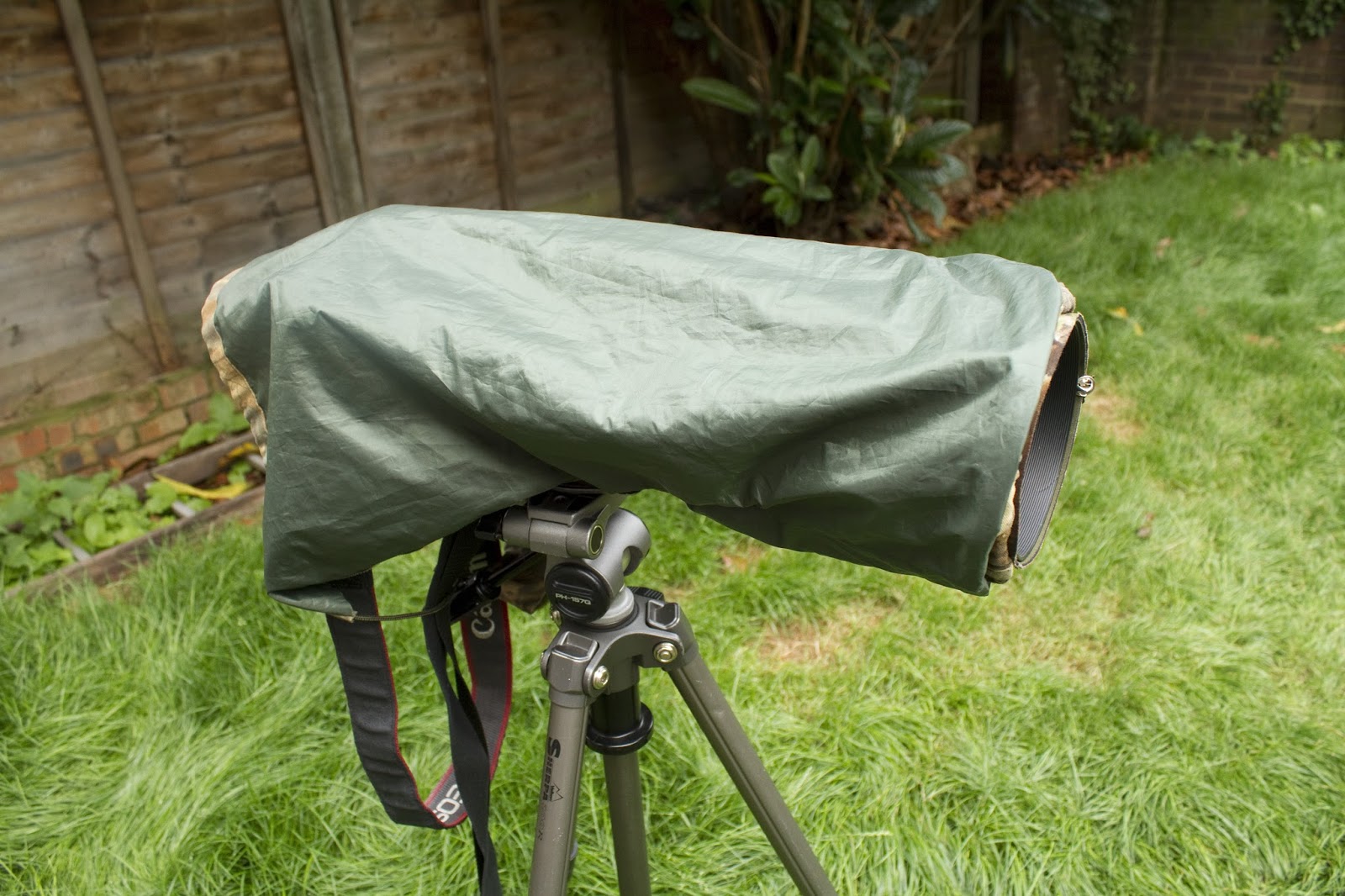
Wildlife Watching Supplies Camera/lens Cover Review.
For a wildlife photographer being able to shoot in the elements is vital to get eye-catching shots. You must however protect your equipment. This is why I always keep a camera/lens cover in my bag when I'm out photographing. I personally use a camera/lens cover from Wildlife Watching Supplies, made in Britain with fine quality Proofed Polycotton in camouflage colour on the outside and uniform olive-green water-proof nylon on the other. The end is elasticated so that it fits snugly on the lens hood covering the whole of the lens, at the front there is a drawstring to cover the camera's LCD screen.
I've used this camera/lens cover for a couple of months now and have been constantly impressed by it. Shorty after I got it I was in Ireland for a week So when the inescapable rain came, instead of staying indoors I went out to test it. I spent around an hour wandering around the countryside getting completely soaked. When I got back inside however the lens beneath the cover was bone-dry. The same couldn't be said for me. I noticed that rather than being absorbed, the rain slides off the cover, but a constant soaking can get into the polycotton. This is no trouble though as it dries surprisingly quickly and doesn't get through the waterproof nylon beneath.
Not only does the cover protect your camera/lens from the elements it also camouflages it and breaks up the outline helping disguise the camera.
The only downside to this product is that it reduces control over the zoom. If you use a prime lens however this will be no problem, I for one use a zoom lens for the versatility it gives.
The camera/lens cover by Wildlife Watching Supplies is a must have for all photographers, it folds up small so won't take up much space in your bag, but most importantly it keeps your equipment safe from the elements.
I've used this camera/lens cover for a couple of months now and have been constantly impressed by it. Shorty after I got it I was in Ireland for a week So when the inescapable rain came, instead of staying indoors I went out to test it. I spent around an hour wandering around the countryside getting completely soaked. When I got back inside however the lens beneath the cover was bone-dry. The same couldn't be said for me. I noticed that rather than being absorbed, the rain slides off the cover, but a constant soaking can get into the polycotton. This is no trouble though as it dries surprisingly quickly and doesn't get through the waterproof nylon beneath.
Not only does the cover protect your camera/lens from the elements it also camouflages it and breaks up the outline helping disguise the camera.
The only downside to this product is that it reduces control over the zoom. If you use a prime lens however this will be no problem, I for one use a zoom lens for the versatility it gives.
The camera/lens cover by Wildlife Watching Supplies is a must have for all photographers, it folds up small so won't take up much space in your bag, but most importantly it keeps your equipment safe from the elements.
Subscribe to:
Posts (Atom)